Showing posts with label culture. Show all posts

Saturday, 1 August 2015

Field diary fragment: some time in June, 2015

Later, in Brisbane, an afternoon off before a one-day workshop at the State Library tomorrow.

I wandered along South Bank, the “cultural precinct” and visited the Gallery of Modern Art, Indigenous collection. Somehow more moving than my usual trips to gallery – why? Felt so humbled and sort of … connected…. Seeing names of languages, places and people I have known/worked with/been to. Gija-Warmun-Galpu-Gumatj-Amata-Pipalyatjarra-Palawa-Ngarrindjeri-Gunjinku…  Like a mantra of defiance, belonging, history.  Not to mention stunning weavings and paintings and string things..

What will happen to this art, so grounded in place, in Country, if the government succeeds in driving people off their land?  Where will it go, what will it look like, what stories will it tell?


Why is it all making me so sad this week?


Thursday, 20 June 2013

A tribute to Gurrumul and his uncle, Mr Yunupingu


On June 2, Dr M. Yunupingu, former Yothu Yindi front man and Gumatj clan member, passed away at his home community of Yirrkala, in North-East Arnhem Land.

It’s often the case that we learn more about somebody’s life only after they die. As it happened, the week Yunupingu died, I had bought a copy of a beautiful new biography of his nephew, Geoffrey Gurrumul Yunupingu, known more commonly just as Gurrumul.

Reading the biography, and seeing the tributes flow for Yunupingu when he died, I became acutely more aware of the role musicians such as these, bands such as Yothu Yindi, have played in the struggle for recognition, appreciation and respect for Aboriginal people, and their languages and cultures.

There is, of course, the obvious. “Treaty”, for example, catapulted the demand for recognition to an international stage. As Robert Hillman writes in the new Gurrumul – his life and music, “All these issues had been spoken of in a politely insistent way for a long time, but the Yothu Yindi people were different – louder, ruder more exuberant than anyone who’d come before them.”

But an Aboriginal musician reaching international fame, singing songs in his own language – like uncle and nephew both – that has had an impact on Aboriginal audiences that is perhaps not obvious to not-Aboriginal, English-speaking fans. Merrkiyawuy Ganambarr, another relative and Yothu Yindi band member, says that Yothu Yindi paved the way for Gurrumul’s acceptance by an international audience as a solo performer.

In Yothu Yindi, he played the drums and then the guitar and keyboards (all of which he taught himself). He was never the front man like his uncle, but widely recognised as the musical strength of the band.

When he went solo, Ganambarr explains the impact his music (performed in a number of his native Yolngu languages, with smatterings of English) had on her, and presumably not just her: “When that first solo album of his came out, I cried. [He sings in a way] that makes them appeal to a white audience. But the expressions he uses in those songs, they’re the expressions we use in traditional songs … People don’t have to know what the words mean. All that they listen to is the voice, and the impression the voice conveys. And when Yolngu listen to it, we understand every word, and the meaning of every word. It’s so powerful.”

Indeed, there is something very powerful and poignant about the international accolades being showered on a Gumatj man, singing in Galpu, Gumatj and Djambarrpuyngu – three languages that, compared to other Australian Aboriginal languages are probably quite healthy, but are still considered critically endangered.

Hillman writes that Gurrumul’s songs don’t touch on politics much – quite unlike his uncle, for example, who when he wasn’t singing “Treaty” was advocating for bilingual education and becoming the Northern Territory’s first Aboriginal principal.

But perhaps there is something inherently political about an Aboriginal musician – from the strong, proud people who famously sent the bark petition to Canberra 50 years ago -- taking his language and culture to Carnegie Hall in Manhattan, to Paris and London. Writing of Gurrumul’s performance with Sting, in France 2010, Hillman writes: “The Gumatj language, the sacred repository of a culture and history older by far than that of France or any country in Europe, older than the entirety of Western civilisation, [was] about to be plaited with the younger, mongrel language of English.”

But mixed up with Hillman’s sublime observations of language and culture are light-hearted sketches of Gurrumul, down-to-earth, irreverent, utterly uninterested in fame.  The song he was meant to perform with Sting was Every Breath you Take, but “Gurrumul, relishing the swanky hotels booked for the tour … is having too much of a good time to commit himself to a whispery song with lyrics that deal ambiguously with love and longing.”

He did, in the end, do the duet, after a few frantic email exchanges between Paris and the far north Australian Elcho Island, where Gurrumul’s relatives translated Sting’s lyrics into first one, then another, of his languages, until they came up with something he was satisfied with.

Gurrumul grew up on Elcho Island, in the community of Galiwin’ku. While in recent years there has been much media focus on the conditions in Aboriginal communities, and particularly the experience of Aboriginal children there, there is something to be said for Aboriginal’s people’s approach to what the rest of us think of as disability. Gurrumul was born blind, but it didn’t hold him back: as a young one, he would ride his bike down Elcho’s famously steep hill, with family members lining the road yelling “go left! Right! Watch the pot holes!”

His family took it as given that his lack of sight would be made up for with other skills, and were not surprised when he taught himself a variety of instruments at a young age. As a left-hander, he famously plays the guitar upside-down, presumably because he had never seen it be played, so just took it as he found it and adapted to suit himself.

 His was a life seeped in an ancient language and tradition – which comes out in his music and continues to move audiences around the world to tears, although they don’t understand a word he is saying. “We come away from listening to Gurrumul with the word ‘beautiful’ on our lips”, Hillman writes, “but where that beauty comes from, its richness and complexity – that’s the wonder…

“The languages of Indigenous Australians, once numbering in the hundred, have roots in even more ancient languages … What listeners to Gurrumul’s voice and music hear is not simply ‘beauty’ but something that is the sound of life itself being honoured.” And surely, that honour is deserved, given the tenacity with which Gurrumul’s languages have survived, against the odds.

Gurrumul – his life and work, takes the reader on a whirlwind rock star tour of hotels and concert halls across Australia, Europe and the United states, as experienced by a blind man from a remote community, from one of the oldest living cultures on Earth. The story is often told from the point of view of his non-Yolngu band members and friends (as Gurrumul does not talk to journalists), who act as his some-time carers, some time cross-cultural guides.

At times verging on hilarity (he may be blind, but he adamantly refuses to wear white socks, leading to some last-minute panics), Hillman’s narrative is broken up with well-researched short essays on aspects of Yolngu language and culture, and stunning photography.

Poignantly, describing a time in 2010 when Gurrumul was dangerously ill, Hillman writes: “Any black Australian who becomes seriously ill in his late thirties has a very remote chance of reaching his late forties. A frightening number of black Australians – both men and women – lose their lives to renal failure, heart disease and liver disorders at about the age Gurrumul is now – almost thirty-nine – and many who are spared succumb ten or twenty years later.”

And so it was for Gurrumul’s uncle, fellow Gumatj, fellow trailblazer.  Mr Yunupingu was 56 years old, and he died of kidney failure.

In her June 5 obituary on The Drum, Tracy Hutchinson wrote: “I doubt there has been a more profoundly moving induction into the ARIA Hall of Fame than Yothu Yindi's last year.
And I doubt there is a more shameful indictment on us all that Mr Yunupingu died from a treatable illness in Australia in 2013. There are no cheap words to describe the magnitude of that.”

There are no words to describe it, and of course, Aboriginal people don't need words - they are living it. 
And the grieving for this particular man will last a long time. But thanks to his work, and also to technology, Aboriginal people from Arnhem Land and across the country can still watch him, painted up in ways that only they fully understand , singing "Treaty" to the world. Yunupingu's legacy is the voice and pride he gave to his people, and that legacy lives on in Gurrumul and others.


Saturday, 6 April 2013

Anderson blames violence on welfare dependency


[Article written by Emma Murphy for Green Left Weekly]

The Northern Territory women’s policy minister, Alison Anderson, told a gathering at the Wheeler Centre in Melbourne that “domestic violence has reached a crisis point”, the ABC reported on April 4.
It is unclear when Anderson thinks this crisis started. Certainly it is not new. The 2007 Little Children are Sacred report, which the then Coalition government used to justify the NT intervention, found “combined effects of poor health, alcohol and drug abuse, unemployment … poor education and housing, and a general loss of identity and control have contributed to violence and sexual abuse in many forms”.
Reports since the intervention have shown many social indicators — including family violence — are on the rise, as a result of the stress, confusion and disempowerment associated with the intervention.
Domestic violence is indeed a problem in Aboriginal communities — in fact there are unacceptably high levels of domestic violence across the whole Australian community. Tackling it will require policies that empower communities, and women in particular, and address the appalling social indicators we see in Aboriginal communities.
But according to the ABC, Anderson has a different analysis of the causes of violence. “Ms Anderson said the root of all evil in remote communities was welfare,” the article reported.
Anderson said that in communities near mines, nobody should be unemployed. “[Centrelink] should say to people in that area: OK, there's 2000 jobs there, nobody will be unemployed … You get out and get yourself a job, and earn yourself real money instead of being a burden on the taxpayer, just to wait for your $375 [welfare]."
Anderson is part of the Country Liberal Party government that came to power in August last year on the back of a strong bush vote. She is one of an impressive number of Aboriginal MLAs and ministers. This includes the Chief Minister, Adam Giles, who recently ousted Terry Mills to become the first Indigenous head of an Australian government.
But so far, there hasn’t been a lot for Aboriginal people to celebrate.
Anderson’s comments at the Wheeler Centre were in keeping with previous comments she has made, which must be like music to the ears of neo-conservatives around the country. She launched the Homelands Policy on February 25, which contained an unlikely combination of supporting her people’s connection to the land and demanding they open it up to private ownership.
She said: “Private ownership of housing is good because it encourages people to take out mortgages … Once you start to think about it, having a mortgage means you can build a better house for yourself and your children. It means you have to get up in the morning and have a shower and go to work to earn the money to pay the mortgage.”
As Jon Altman has written on news website Crikey, Indigenous people are overwhelmingly resistant to the idea of private home ownership.
Meanwhile, Anderson’s proposed solution to domestic violence — ending welfare in communities by forcing everyone to work in the mines — ignores the reality of Aboriginal employment trends. According to the 2006 Census, 176 Aboriginal people in the NT were employed in the mining industry, compared with more than 4000 in public administration and safety, and 2000 in health care and public assistance.
It is difficult to know whether the low numbers of Aboriginal workers in the mining industry reflect discrimination, Aboriginal people’s choices about work or the relatively limited employment opportunities created by mining. Certainly Anderson ignores the campaigns that Aboriginal communities have waged in resisting mining on their country.
Fifty years ago Yolngu people sent a bark petition to Canberra to protest Nabalco mining bauxite on their land. They lost the fight and the mine, now operated by a subsidiary of Rio Tinto, is still at Nhulunbuy.
Today, the people of Maningrida are fighting against an oil exploration application over their country.
Is telling these strong fighters and custodians of country to get off welfare and into the mines really the best thing the CLP government has to offer?
In her Wheeler Centre address, Anderson also lamented the poor NAPLAN test results for Aboriginal primary school children in the Northern Territory.
She was clear about who was to blame for what others might describe as a systemic failing of Aboriginal people: “The younger generation are not forcing their children to go to school … They don't see the importance of a good education, they don't see that education is the key.”
However, the 2008 12-month review of the NT intervention found that parents and elders in communities were concerned that the next generation was not reaching national standards of English, and they were worried about “the impact this [had] on individual and community capacity”.
The report highlighted a sense that schools were not “important … for social and cultural development” because of “Aboriginal language and culture [not being] seriously incorporated into the formal school curriculum”.
To make schools more relevant, which would increase attendance and outcomes, the CLP government could re-introduce bilingual education. But that does not look likely any time soon.
On October 25, the ABC reported Anderson as saying she believed “Indigenous children should be taught in the same way as students in Sydney … ‘I am not suggesting we abandon our traditional culture or language but teaching them should not be done in schools, it should be done after school and on weekends, and during the holidays,’ she said.”
For Aboriginal Territorians dreaming of an English-only future of working in the mines and being tied to a mortgage, the CLP government might just have the answer.
But for those who value the linguistic and cultural diversity among the oldest continuing cultures on Earth, and for those Aboriginal people who believe they have the right to pursue different values and different ways of being — on their own country — it seems the struggle did not end with the arrival of black ministers in the NT parliament.

Saturday, 10 November 2012

Turns out one can enjoy India

After a rather lengthy absence from the blog (absence, indeed, from many things but that's another story), here I am, back to tell you I have just been in India.

I have been to India before, and had quite  traumatic experiences. Indeed I was more surprised than anybody when I decided to head back to the subcontinent this year to celebrate a friend's 60th birthday - India is pretty much his second home these days, so he decided to celebrate the event Indian-style, and invite a few of his Australian friends along.

Off I went, slightly trepidatious but willing to give it a go, knowing I'd be with lots of "grown-ups" this time (last time I was a slightly naive 19 year old who insisted on learning everything the hard way).

It certainly  is different travelling with a man in India - for all the wrong reasons, I suppose, as it does say something about the position of women in India. But I have to say being totally utterly ignored by men, who would automatically speak only to my father, was a slight improvement on the sorts of attention I got from men last time I was there.

Enough said on that topic, methinks.

The point is, I discovered beautiful things about the county. Even, dare I say it, peace and calm - quite a departure more the chaotic madness that is Delhi and other large cities I've visited there in the past.

Some photos are in the next post. More will come, especially if someone can tell me a  quick way to post many photos online at once.... :)

Some pics from India

DelhiDelhiDelhi breakfastDelhi intersectionDelhi skylineDelhi streetscape
Delhi streetscapeDelhi streetscapeDelhi, Red FortDelhi, Red FortDelhi, Red FortRishikesh
Rishikesh footbridgeRishikesh monkeyRishikesh monkeys

More to come... I became impatient with the slow photo uploading process...

Saturday, 18 August 2012

Thursday night at the markets

On Thursday evening, fired up after a bit of healthy protesting with the Bagot community, I rode down to  the Mindil Beach markets, hoping to run into some friends, regular market go-ers, and give them their copy of Green Left Weekly.

Suggested to Pete he might want drive  down later and have dinner there (code for I don't want to ride home up those hills, will you come and get me?). Arrived at the markets, Anja and Michael weren't in their usual spot, realised I'd left my mobile at home - oh no! How would Pete find me! I'd have to ride home afterall....?!

Anyway it all worked out fine, of course. Yummy food was eaten as the sunset over Mindil beach and fire performers did their thing. We ate very early, looking forward to an early, quiet night at home.

Headed back to the car. To find that we were surrounded on all sides by other parked vehicles. None of this  two-neat-lines of car parks rubbish for the wild Territory. No, people park on traffic islands, verges, footpath, the beach... wherever they can fit their wheels, pretty much. Which, on Thursday, meant all around our Patrol, thus blocking our escape on all sides.

So much for a quiet evening at home.

Fortunately it is Darwin Festival time, and one of the Festival Parks happens to be in the Botanic Gardens, just opposite the markets. So we went over the road, lolled around on the outdoor furniture, among the palm  trees, under the fairy lights, beside the spiegeltent, drinking  cider and trying to estimate at what time drivers of a certain (very funky) purple ute might be leaving the markets that evening.

Got back the car park, and yay! Purple ute is gone! Only to be replaced by another car. Sigh.

Some highly skilled and very patient manouevring  finally had us squeezing out, much to the disbelief of some passing rather intoxicated lads.

And that was our Thursday evening.


Sunday, 12 August 2012

NIMAs: Indigenous music's night of nights


Last night, on a cooler than usual August Darwin night, we huddled under the stars for the 2012 National Indigenous Music Awards (NIMAs).

There was no red carpet, just the wonderful natural amphitheatre in the botanic gardens. Apart from Indigenous outlets, there was little or no media (in a Google search today, only  one short piece on ABC comes up).  The event is one of  the few where there are about equal numbers of black and white Australians in the crowd  - the other that springs  to mind is the football, when the  Tiwi Bombers are playing.

But over the course of the evening, the crowd was reminded of just how much we have to  celebrate, and seek inspiration from, the talent and creativity held within Aboriginal communities, urban and remote, across this enormous continent. “Mainstream” Australian society could do with more exposure to this stuff, rather than the endless reporting on the violence & dysfuntion that is supposedly tearing Aboriginal Australia apart.

Thelma Plum from Brisbane took out this year’s triple j NIMA Unearthed award: her voice took my breath away. A highlight of the evening was when Plum joined Queensland band The Medics (who took out best song, best album, and best new talent) and the legendary Bunna Lawrie from Coloured Stone for a hauntingly beautiful rendition of Blowin’ in the Wind.

Maningrida rock outfit Sunrize Band reminded the crowd that land rights are still an issue to be defended. Described by Rolling Stone as “a swinging Arnhem Land blend of Hendrix, Neil Young and didgeridoo”, Sunrize Band was inducted into the Hall of Fame, as was the Lajamanu Teenage Band and the late Jimmy Little, who mentored and inspired much of the talent on display at the award night.

A new Arnhem Land band, East Journey, mentored by Yothu Yindi’s Mandawuy Yunupingu, took out the NT Film Clip of the Year and the G.R. Bururrawanga Memorial Award for outstanding contribution to the NT music industry.

The young men of East Journey blend contempory and traditional instruments, English  and Yolŋu Matha, smart button-down shirts and body paint in a proud display of the two worlds they inhabit. Knowing the  shyness and awkwardness felt by so many  young Yolŋu, who so often feel so lost  in the ever-changing reality of their  worlds , just heightened the appreciation of this group’s bravery and pride.

Desert bands were also well presented on the night. Well-loved country musician Warren H Williams has recently released taken the bold step of releasing an album in his language, the language of the Waramungu people.  He was performing with the Waramungu songmen, showcasing his new fusion of two Indigenous languages and modern and traditional beats. Warren and the songmen shared the Traditional Music Award with Shellie Morris and the Borroloola  Songwomen.

Lajamanu Teenage Band were a local favourite when I lived at  Irrunytju Community in WA 14 years ago. No longer teenagers, the band still manages to speak straight to the heart of many of  the issues facing young people in Aboriginal communities:  drug  and alcohol use, family,  community and country. They were also  inducted into the Hall of Fame, and celebrated by closing the night with a rousing set, performed to countrymen  and women who had travelled from across the Territory to see them.

After the show, we caught the free shuttle bus home. We were pretty much the only whitefellas on that late-night bus, whose route takes in some of the larger town camps. We surrounded by people from different clans and nations – desert and saltwater – bursting with pride in family members who’d performed, singing along with snippets recorded onto smartphones, talking about who they might see on the stage next year. 

It made me think about how there is a huge part of Aboriginal Australia that most people just don’t see: the  family part, the successful, talented, professional and beautiful part.

If more of us did see it, would the mainstream media and the politicians be able to get away with their  racism as easily as they do?

Check out some great new music from Indigenous artists:
Gurrumul and Sarah Blasko:   http://www.youtube.com/watch?v=oGxXobjjacY

Saturday, 28 April 2012

The postcard from vietnam

So, this is to make up for the fact I'm so slack at writing postcards. And it will probably be as brief as a postcard too, as any minute now I shall need to find a toilet - not  necessarily an easy feat in Hanoi.


We just went to Halong Bay, apparently one of those places on the planet you're meant  to see before you die etc ec, and spent two days and a night on a boat. It was rather pleasant - particularly after coming from Hanoi which is humbug central- to have two days of travel,  meals, accommodation, activities organised for us.And Halong Bay is pretty  eery and spectacular- massive limestone peaks and monoliths just sticking out  of the very still (somewhat  polluted) water.


We visited an enormous, incredibly impressive cave (Pete wants to get a map of it and set a D&D game there), and climbed a painful number of steps on one of the islands (literally painful, my thighs are still cranky)- the veiw from the top was  breathtaking though.


On our boat were a few very lively Brazilians who somehow had us singing karaoke at night - something I'd promised myself   I'd never do. It took a fair few glasses of wine -  which we felt the next morning when we were up bright and early  to kayake around a floating fishing village hidden among the íslands...


We were a bit disturbed by the number of dead fish floating on the surface, and, well - let's face it - the pollution was so bad we didn't sê the sky for two days... But it was still a relaxing few days, nice hanging out on a boat.

Back in bustling Hanoi now, heading down to the central coast tomorrow. Today's mission: find a cinema playing the Avengers in English...

Tuesday, 29 November 2011

#Occupy movement kapows comics

The Beginning of the American Fall
Stephanie McMillan
Cartoonmovement.com

The Adventures of Unemployed Man
Erich Origen and Gan Golan
Little, Brown, October 2010. 80 pp.

Action Comics
Grant Morrison
Detective Comics

The worldwide Occupy protests have inspired a lot of music over the past few months. But it has also broken into artistic circles some might not know of. One such area is comics.

Stephanie McMillan, the creator of the Minimum Security comics, has created a seven-page comic of her experiences when the Stop The Machine and Occupy DC protests united on October 7.

Unlike the other comics (and her own work in MS), The Beginning of the American Fall deals with conflicts and difficulties of bringing the two protest groups together.

It also details the day-to-day organising challenges, such as decision-making, food and sanitation for the protest camp.

Other comic artists have been documenting the struggles of the Occupy movement. On November 16, ComicsAlliance.com featured a spread of comic artists showing interviews of people at the protests.

Last year, Erich Origen and Gan Golan launched their response to the financial crisis in the US with The Adventures of Unemployed Man. The comic is set in a world where everyone is a superhero, but the economy has doomed most to live in the tent city of Capetown.

Unemployed Man fights alongside fellow superheroes Wonder Mother, the student debt-ridden Master of Degrees and the “invisible” migrant worker Fantasma. Together they fight the League of Just Us and the forces of the Invisible Hand.

Although it was launched before the occupy movement took off, it quickly became popular. Unemployed Man and his fellow heroes were popular costumes at Ocuppy Portland in the US over Halloween.

The art and storytelling style of UM is similar to the classic works of Jack Kirby, who created Captain America, and Jerry Siegel and Joe Shuster who created Superman. This is an homage to the classic creations.

But the Occupy spirit has hit mainstream comics as well. On August 31, DC comics relaunched its entire line of titles. Many changes were made to iconic characters, and among them Superman got a facelift. His tights were replaced by jeans and he now fights injustice against the wishes of the authorities. This is both as Superman and in his alter ego as Clark Kent, crusading journalist.

Action Comics writer Grant Morrison told Wired on July 19: “ I’m looking back at the original Superman as a champion of the oppressed, and not necessarily a figure of law and order or patriotism.”

Wired also featured artwork by Anjin Anhut showing Batman as Bruce Wayne with a sign saying “Raise My Taxes”, evoking the call by milionaire Warren Buffet to do the same.

Multimedia producer Matthew Pizzolo has created a project called Occupy Comics to unite some of this work.

“I think Occupy Wall Street needs art more than it needs a list of demands,” Pizollo said on the website. "I think artists and writers of comic books have a unique ability to evoke broad ideas and ideals in captivating, dramatic ways.

“Comics is a small world compared to scale the protests have taken, but think globally act locally, right? A single piece of art can ultimately transcend everything else.”

Occupy Comics is new, but it is seeking to raise funds to support the movement and promote its ideas. Check it out at Occupy Comics.

Reprinted from Green Left Weekly.

Sunday, 13 November 2011

Digital TV and Aboriginal Languages and Culture


Language and education specialists are concerned the federal government's national roll-out of digital television will have a detrimental effect on the preservation and transmission of Aboriginal languages and cultures.

In 1987, the Broadcasting for Remote Aboriginal Communities Scheme (BRACS) was  established, to balance the introduction of mainstream TV channels (via satellite) into remote communites with some local control and  ability to broadcast local content. Typically  this saw communities having free-to-air access to between two and four mainstream channels, plus Aboriginal-content channels such as National Indigenous Television (NITV) and Indigenous Community Television (ICTV). A lot of ICTV's content is in Aboriginal languages, and is produced by Aboriginal people in their own communities.

Apart from NITV and ICTV, BRACS also  allowed individual communities to broadcast local content.

In her joint submission to the inquiry with Dr William Fogarty, Dr Inge Kral, a research fellow at the Centre for Aboriginal Economic  Policy Research, emphasised the central role multidmedia technologies,  specifically video production, play in contemporary remote Aboriginal life. "Where young people have access to resources they are engaging in digital cultural heritage projects and creative cultural multimedia and music production for broadcasting, festivals and enterprise. Importantly, such activities commonly incorporate Indigenous languages", she said. "Here young adults are exhibiting pride in Indigenous language and culture and modelling of purpose for mother tongue and English language literacy for the next generation."

With almost total unemployment on communities, and limited formal education opportunites beyond school, boredom is a huge factor, particularly for young people. Increasingly, community media and resource centres are becoming places of informal learning, cultural expression and language maintenance. Kral pointed to the popularity of music recording software, which will often also inspire young musicians to film music clips, design CD covers and upload resources to the web.

The ability for such youth-initiated, local content to be broadcast to the community in turn fosters cultural pride and encourages further engagement and activity.

But the digital TV roll-out threatens this flowering informal Aboriginal media industry. The roll-out, according to Kral, will undermine communities' broadcasting ability, as direct satellite-to-home technology replaces the current communtiy-based transmitters. She  told the inquiry: "Remote communities will have 16 channels of mainstream, monolingual, monocultural English language TV and no Indigenous services. This will lead to an onslaught of Western English language images and cultural content.

"It will see an undermining of the motivation for Indigenous youth to participate in activities and training leading to a potential area of employment in the enterprise generation. It will also impact on Indigenous language and culture maintenance and it will hinder one important means by which community pride in Indigenous languages is generated."

The Indigenous Remote Communcations Association (IRCA), in an October submission to the Department of Broadband, Communications and the Digital Economy, noted: "For many remote Indigenous people, convergence spells an increasing threat to their fragile linguistic and cultural world, with western media and values distracting young people from gaining cultural knowledge. They feel like a tsunami of mainstream media and communications is bearing down upon them via the internet, 16 channels of digital TV and new media platforms."


In September, communications minister Stephen Conroy announced SBS and NITV would enter discussions about a possible merger. If successful, this could ensure the continuation of NITV, and mean it was accessed by more people, as it is currently not a free-to-air service. But some argue NITV, while valuable,  cannot replace local community-produced content. According to IRCA, "NITV tends not be popular in most remote communities with the programming, typically in English with urban presenters, not regarded by remote viewers as reflective of their experience, views and cultural identity".


IRCA has also pointed out, in Joining the Dots: Dreaming a Digital Future for Remote Indigenous Media, that the benefits of direct-to-home TV technology assume a particular way of accessing media - a particular way of life - that doesn't necessarily apply to remote Aboriginal communities: typically, people move from house to house, watch television outside in large groups, use exention leads to take TVs to sorry camps away from the house.


Remote Aboriginal people  - particularly young people - are embracing new technologies at an impressive rate. Far from this signalling a threat to their language and culture, research is proving that new technologies are  being adapted and used to maintain, share, and develop cultural and linguistic heritage. For this to continue, it is vital that any technological upgrades do not come at the expense of local control of content, linguistic diversity and equal access to content production. Young Aboriginal people are showing that embracing the digital age is not at all at odds with celebrating and expressing one of the oldest continuous cultures on Earth. Can the digital TV roll-out improve their access to technology without sacrificing their control over it?

Books I've enjoyed this year

A non-exhaustive list, in no particular order


* * *


Borderliners, by Peter Hoeg
The Last of the Nomads, W.J. Peasley
Life of Pi, Yann Martel
An Intruder's Guide to East Arnhem Land, Andrew McMillan
Education for Critical Consciousness, Paulo Freire
Teaching to transgress, bell hooks
Too Many People? Ian Angus and Simon Butler
The Blind Assassin, Margaret Atwood
Grog War, Alexis Wright
Green Mars, Kim Stanley Robinson
Usage and Abusage, Eric Partridge
 Donald Thomson in Arnhem Land, Donald Thomson
Critique of Intelligent Design, John Bellamy Foster, Brett Clark & Richard York

Wednesday, 2 November 2011

Darwin Roller Derby

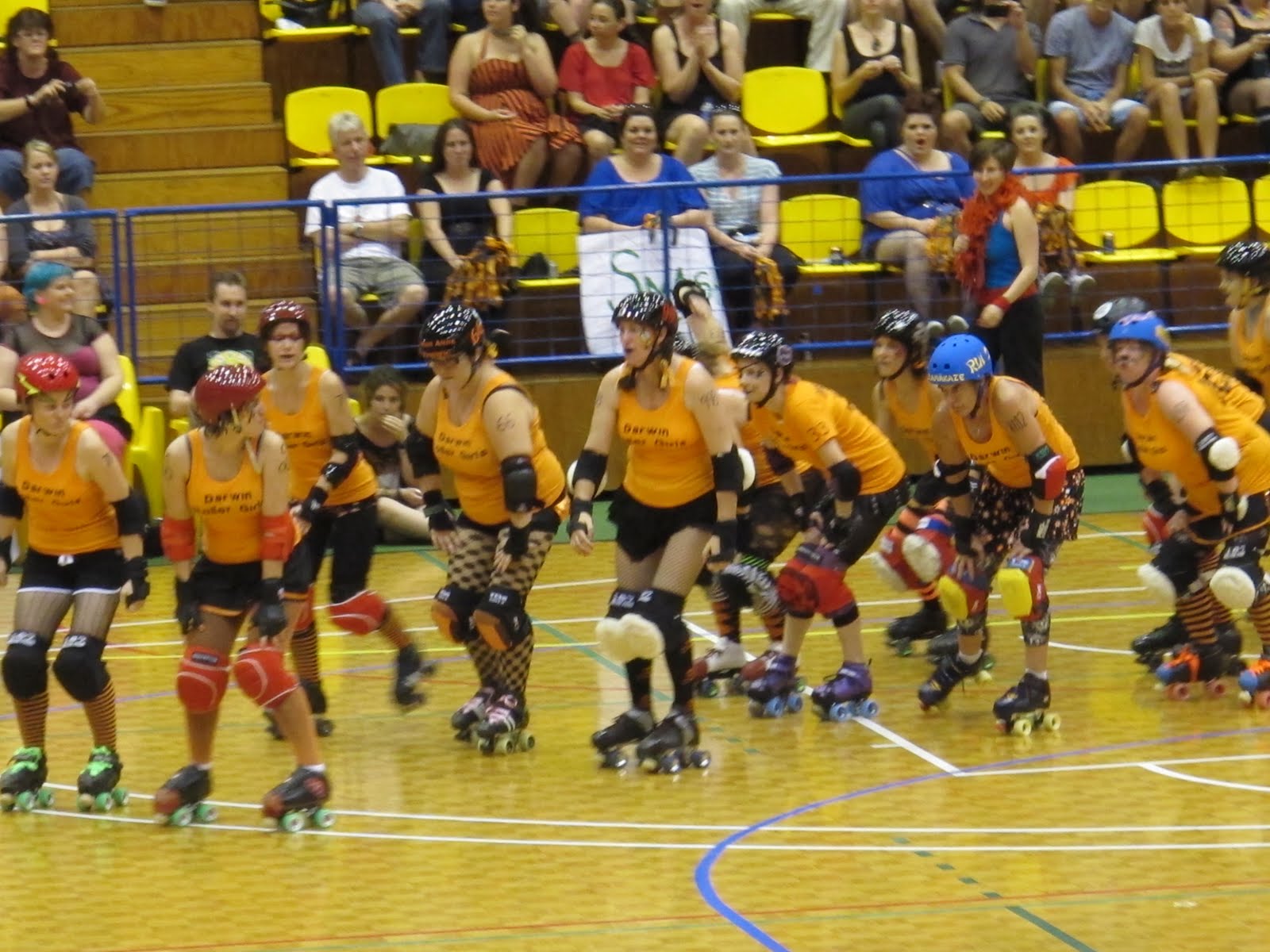
On Saturday I went to the first ever roller derby bout in the NT - a grudge match between the Darwin Roller and Malice Springs.


The stadium was packed out for the bout, 1400 people inside and 200 turned away at the door. I was lucky to find a scalper a couple of days before. (Not really a scalper, just someone who had bought too many tickets)

The bout was opened by Aunt Millie singing Arafura Pearl, which was a nice touch I thought.


The ony thing I knew about roller derby was from the movie Stick It, which I'd originally assumed from the cover was about polo. I'd only half-watched the movie and been distracted by the romantic subplot and missed out on the actual rules.

Fortunately these guys were there to explain it to us.


Two teams of five roll around the rink. The first four of each team are the blockers. Behind are the jammers. The jammers try to push to the front of the pack and the blockers try to stop them. If a jammer succeeds the bout then becomes a jam. The jammer can now score a point for every blocker they overtake. The jam ends after two minutes or when the jammer indicates by putting her hands on her hips (usually they indicates by chopping their hands to their hips as if indicating they want their legs cut off here, but you get the idea).

Blockers aren't allowed to use their arms or hands, nor are they allowed to trip anyone over. There's a sin bin for such things. Blockers mostly use their hips and can push jammers out of the ring. Jammers can come back in but only behind the blocker who pushed them off.

Otherwise they go to the sin bin:


Bruising and rink rash often occur as does some serious knee-wrenching. The crowd loves it.


The game isn't just about violence though. A lot of the appeal of the game is in its pagentry. Roller girls have a punk aesthetic. They choose a nickname they dress like punk or goths as part of their uniform.

Here's the Malice Springs team:


Fifth from the right is "Ruff Trot". Here's the DRG:


The costumes are amazing. Look, even the refs get into it:


This is another one of the officials:


Fans too:


I'll show some actual game shots now:


The bout was exciting. DRG dominated early, particularly because of their blockers. In the second half, Brutally Blond from Malice Springs led a pretty valiant effort to narrow the gap, but in the end:


Darwin won convincingly.

It was a fantastic night and I highly recommend it to anyone who likes fun.

BONUS STUFF

The half-time show was unicycyle polo:


!?

Monday, 10 October 2011

DNA, rock art, and monolingual governments

"DNA sequencing of a 100-year-old lock of hair has established that Aboriginal Australians have a longer continuous association with the land than any other race of people", reported ABC Online on September 23.

The DNA taken from an Aboriginal man in from the Western Australian Goldfields in 1923 revealed he was a descendant of people who migrated from Africa into Asia around 70,000 years ago. Dr Joe Dortch, an archeologist at the University of Western Australia said: "It shows Aboriginal Australians have the longest branch of history in one particular place of anyone in the world. No one else in the world can say 'I am descended from people who have been here 75,000 years'."

I read this article after spending a weekend in Kakadu National Park, a stunningly beautiful part of the country - world heritage protected, Ranger Uranium Mine notwithstanding.

We had the opportunity to check out some spectacular rock art while we were there. (I call it rock art in my ignorance, not knowing what important stories, legal issues etc it represented - see my Yirrkala Bark Petition blog post for more information.)

Some cave walls had different layers of painting overlapping each other, and you could see different styles from different eras. We were looking at some of the X-Ray and cross-hatching styles- you maybe familiar with the style: outlines of people and animals with incredibly detailed anatomical information within the outline (X-ray style). I overhead a ranger telling some tourists that this was the modern art style for this region. I guess that's why it was over the top of more simple, faded designs.

Anyway, without missing a beat, having identified it as the modern style, he went on to say "So we're looking at 8,000-10,000 years ago."

I think my heart skipped a beat. Or something happened inside me, anyway. Aboriginal people have been living on, and caring for, this country, for a very very long time. Which I guess we all know, although you wouldn't think there was anything special about that if you were to consider current government policies.

I thought about European art, and how every century or so heralds a new "age" in art. And once we get back to before the birth of jesus, we're delving into "ancient" times - ancient languages, ancient civilisations. I used to want to study Latin or Ancient Greek, I thought it would be fascinating to learn a language spoken in "ancient times".

And here I am, living and working, and learning the languages of, people who have been here for tens of thousands of years. And are still here, speaking those languages. At least, some of them. Australia has the fastest rate of language extinction in the world, according to UNESCO. Go to this site and type in Australia for country: http://www.unesco.org/culture/languages-atlas/index.php It gives you a sense of the state of Australia's first languages - though I think the situation is probably worse than the map indicates, given there is nothing marked for Victoria, very little for South Australia, etc.

So, what do we make of this picture? We have on this continent some of the world's oldest cultures, oldest languages, and people with the longest continuous connection to the land. The Aboriginal languages are the only languages adapted over thousands of years to the Australian environment, and the contribution these languages could make to understanding the environment, and to climate change mitigation, is unmeasured- although we do know, from exemplary researchers such as Jon Altman that people living on country and practising customary land management does contribute to ecological sustainability.

And then we have the government. The monolingual, introduced, capitalist Australian governments that are hellbent on banning bilingual education in ther Northern Territory, moving Aboriginal people off their traditional lands and into larger regional centres, "mainstreaming" them, and withdrawing all support from homelands and outstations.

And that is all I have to say today.

Wednesday, 28 September 2011

Bilingual education and Yolngu identity: "The land itself can speak"

Recently I have been thinking/writing lots about bilingual education, what it is, what it means, why it matters. I have been hanging out in Yirrkala and Galiwin’ku (Elcho Island) learning from many Yolngu, who don’t need to think academically about why bilingual learning is important- they feel it in their hearts, they feel their language intrinsically tied up with the environment to which they belong and the spirit of who they are.
I have many many hours of amazing recordings I would eventually, somehow, like to share. I am about to go away again but have this small piece to share now.

I caught up with Yiŋiya Guyula a Liya-Daḻinymirr man from the Djambarrpuyngu clan of North-East Arnhem Land. He is a Senior Lecturer of Yolngu Studies at Charles Darwin University. He’s also my uncle, through the clans system into which I’ve been adopted.

We had a bilingual conversation about bilingual education! My Yolngu Matha isn’t yet good enough to commit to transcribing the whole thing, but here is a section of the English story…

* * *
I think it’s very important that Yolŋu students must speak their first language. That’s when they start growing up from a little child. They must know how to speak fluently ga properly. And then when they grow up, growing older, they must learn their own language – not a mixture of different languages that mixes in the community. They must learn their own tribal language as well.

I think what the government should do is consult- do it properly, consult. They shouldn’t just make up their mind, “this is what we want to do”, because they have the power or the money or whatever. They should come and consult and ask, and we should do it together.

My strong feeling is that bilingual language, bilingual education, should be equally done, as English language. Whether in class – because, in class, if English is just being taught – I think it should be bilingual, Yolŋu Matha should be taught in classes as well. It should be done at home, too, so afterwards, they can go back home and learn their own language, speak their own language. But is should be maintained, balanced, and the government and the Yolŋu out there should be confronted and consult with one another, how we should go about it. Whether to do bilingual education in classes as well or not. We should be asked about that.

[…A few minutes of Yolŋu Matha….] so it can be written, Yolŋu Matha can be written in classes, using Balanda (English - non-Yolngu) letters. At home, and out bush, children can learn, writing the same story through paintings, through artefacts, through songs and dances. And that is writing, writing a story, that is illustration on what a life of a Yolŋu should be. So, it should be written in Balanda way, in the classroom, along with English, and outside, at home, it can be painted. The story can be painted, and that is writing in Yolŋu culture, I believe.

And through working at artefacts, miyalk can learn how to weave baskets, men can learn how to get the right wood for spears, and woomera, ga clapsticks. And sing, sing that song, ga dance that song. So, that’s what I believe.

In Yolŋu Matha language, we have our own context of using languages. There are language that we can use day to day, saying nhämirr nhe and write that down on a board, on a paper, computer, whatever. This is just day to day language that we used. As the child grows older, they go deeper into who they are, getting the knowledge about what the land offers.

And there are bunggul (ceremony- legal, funeral, initiation etc): the language in songs and dances. The language in what the bark paintings hold, the language in the way to hunt, which way to go, what the wind is doing. The calculations of Yolngu Matha- there is mathematics in Yolngu Matha, and there is mathematics in English. So people should learn – they should start writing, in class, about this.

As the child grows older- towards 15, 16, that is when initiation ceremonies take place for them to become young men and women. And they should be able to write [about] those – either write them on the paper, through English way of writing, and go back home and write it in the form of paintings, bark paintings, and through the artefacts, and through songs and dances, the language that we use.

I think the best place to do a Yolngu education, bilingual language ga even Balanda education, is on the homelands. Homelands is the place where the story is, that is where the songs and dances are, that is where your identity is. It’s not in someone else’s community, it’s not in big towns where children are being disciplined through not much – distractions, television, earphones… You see your kids walking around with mobile phones with music sticking in their ears. I call that no discipline, undisciplined.

I am very against the earphones that our children listen to today. It is just disgusting, I hate it. I tell my children, “Don’t ever go the Balanda way. Take that thing out of your ears and listen to what the old people are saying. Listen to what the words in the songs and ceremonies are saying. Listen to what grandparents are telling you.”

And education on the homelands needs to be equally balanced. You take your children away from homelands and put them in boarding schools in town, they only learn about Balanda ways of living, Balanda language. And they’re missing out on something, on their culture.

I know, this happened to me. When I started working with the Mission Aviation Fellowship, I went down south. And during the age that I was, when ceremonies and everything was happening back home, and I was missing out on all that. And I nearly lost my culture, I nearly lost my language.

So I dropped everything, and had to come back home. To catch up. I came back just in time to participate in ceremonies, culture, songs and dances. And I am glad now. I was able to maintain both educations. Balanda ga Yolngu education.

The best place to teach our children is on the homelands, so they can see what plant we are talking about, they can see what image we are talking about – this is the image of the miyapunu (turtle), and you can hold it. You can stand on the ground and the spirits of your fathers are speaking – your own fathers are speaking from the ground where you belong. When I’m out here, in the big cities surrounded by brick walls, when I talk about the images to my children, they can’t really see what I’m talking about, unless they actually go out there. The land itself can explain. The land itself can talk.

And through Balanda way of studying on homelands – that’s where government needs to come in and give us access to fast internet services – skype, learning through teaching our students on country, from country.
I’ve done a lot of teaching on skype, from communities. Actually standing on the ground. And I’ve taken students on field trips, and I’ve spoken to them. And as soon as I speak , and start teaching, straight away the students understand what we’re talking about, because the whole country is talking. The whole environment is speaking, at it is alive.

And that’s what should happen to our children. They should pick up their education on the lands, on the country. The homelands must be supported by government. The government is wrong when they say there is no funding for homeland education, and [they] think [they] know the best is for Yolngu children to come into mainstream education centres. But I say they are wrong. Mainstream education for Yolngu must start on the homeland. That’s what I believe.

I think bilingual education did work – it did work and I am one of the students that learned both Yolngu Matha and Balanda Matha in class in school. And now I am here, working in the university teaching language and culture. I sometimes help John with grammar, suffixes, Yolngu Matha. In a way, that never spoiled the idea of education.

Yolngu Matha, bilingual language, bilingual education,  was never in the way of mainstream education, balanda education. It fitted very, very well. It fitted perfectly. A lot of us are now teaching and I am able to write and I do lots of transcriptions, translations, for the stories that our old people have recorded. And they are there and I do lots of translations, transcriptions.

If I had never learned Yolngu Matha through bilingual education, like I did back in the ’70s, the late ’60s ’70s, I would never have got this far. I am here and at community as well. I teach language and culture to my children, the Yolngu children back home.  And I teach language and culture to the mainstream — the balanda who want to learn, to do a part for their degree, for what they are studying. And when it comes to Indigenous studies, that’s where we come in. And that’s where I feel I come in strongly and I know I am fluent in both English and in Yolngu Matha writings.

So it did work and it does work and it is working for me right here, right now. 

Let’s build a bridge to close that gap. That’s what I believe. Let’s build a bridge together. You don’t build it for me, we’ll build it together.